
Lost in Adventure: a point-and-click laid out on the table, best savoured as a pair

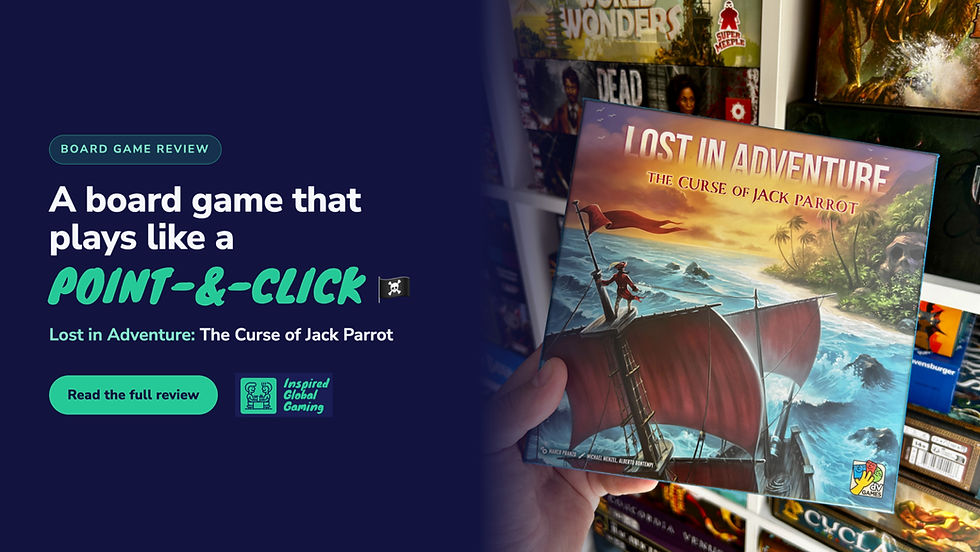
Some games send you straight back to your first video-game loves. As I laid down the opening cards of Lost in Adventure: The Curse of Jack Parrot, I rediscovered the feeling of a good old point-and-click, that "click here, pick up this object, talk to this character" I used to do as a kid in front of a screen. Except here, everything happens on the table, one card after another. My problem is that I never managed to finish it in one sitting. Short on time, I picked it up again at several different moments, and each time I ended up starting all over from the beginning. From my very first game, in fact, one precise and slightly frustrating memory sticks with me: I had missed the action with the snake. I discovered it as a pair, and that is already an important piece of info I will hand you right away: this is how this pirate game gives its best.
Publisher: DV Giochi · Designer: Marco Pranzo · Art: Michael Menzel & Alberto Bontempi · Year: 2025 · Players: 1 to 6 (best with 2) · Duration: varies with the mode · Age: 10+
A pirate choose-your-own-adventure
The pitch fits into a curse and a name that reeks of rum: Jack Parrot. You are deep in buccaneer territory, chests, islands and double-crosses, and the game unspools its story like a choose-your-own-adventure book, only far more tactile. On the art side, the name Michael Menzel is no small thing for anyone who knows the hobby: this is the hand behind Legends of Andor, backed here by Alberto Bontempi. Which is to say the world has real presence and makes you want to turn the next card.
The key thing to grasp is the nature of the beast. Lost in Adventure is not a game to optimise or to replay a hundred times. It is a crossing, a story to live through once, well told, where the pleasure comes from discovery and from choices. If you are after an engine of combos or mechanical tension, keep walking. If you want to climb aboard a story and unfold it at your own pace, step on deck.

How you play
On the table, you build the set as you go: you place Scene cards side by side and move a little meeple around to explore the locations you reveal. Each Scene brings in Interaction cards. Some are mandatory and trigger straight away, others wait for you: you choose to activate them, you flip the card over and read the back to find out what happens. It is exactly the point-and-click gesture, minus the mouse.
Alongside that, a deck of Item cards, marked with letters and numbers, lets you interact with the world. And this is where the game gets clever: depending on the item you decide to use, the outcome changes. You open up branches, you close doors, because a used card goes to the discard pile. Feat cards give you your objectives, and eight Reputation tokens rise or fall according to your decisions, a reminder that your choices carry weight. The rules themselves amount to very little: almost everything is written on the cards, and you learn as you play.
On paper, the game is built for pausing: you tuck your cards into a bag, the Scenes tell you how to set everything back up, and you are meant to pick the adventure back up the following evening. In practice, I got stuck on its length. Without a slot wide enough to finish it, I came back to it several times, and at each restart I preferred to set off from the beginning rather than dive back into a half-forgotten game. That is probably as much a matter of my own playing rhythm as of the game itself, but consider yourself warned: it is better to set aside real blocks of time for it, or to run it across sessions close together so you do not lose the thread.

What hits home, what grates
What wins you over is the immersion and the ease of entry. You step into the story right away, with no brick of rules to digest, and you let yourself be carried by the narrative and the lovely art direction.
Then there is the question, central here, of the player count. To my mind, the ideal setup is two. You share the choices, you argue over which item to bring out, you move forward together without anyone getting bored. Solo, it is perfectly fine, but I prefer living the adventure with someone: a story is meant to be told together. On the other hand, as soon as you go up to three or more, one player almost always ends up on the sidelines. The reason is simple: you only steer a single character, and with several hands on one destiny, one of them inevitably watches more than they play.
The real drawback is replayability, or rather its absence. The backbone of the story stays the same from one game to the next. Once the curse is lifted, you have seen it all, and all that is left is to read through the branches you did not take, out of curiosity. Good news all the same: nothing gets destroyed, so you can gift your box or lend it to a friend once the adventure is over. Add to that the fact that it needs space, a lot of space on the table, and that keeping track of the items can get a touch tedious as they pile up. Finally, the lightness of the rules has its flip side: you will run into the odd fuzzy point and have to make the call yourself. In a game built for optimisation, that would be a deal-breaker. In a narrative adventure, you take it in stride.
Verdict
Lost in Adventure: The Curse of Jack Parrot is a fine narrative escape, one to keep for those who love living a story more than they love winning. It is a living-room point-and-click, generous in atmosphere and easy to pick up, ideal with two, honest solo, and to be avoided at four or more unless you want to leave someone on the bench. Do not buy it to wear it out, buy it for the crossing: a good pirate evening, or rather a few evenings, and the pleasure of having turned every card to see where the curse led.


Comments