
Bureau of Investigation: when Sherlock Holmes loses his mind in Arkham


Bureau of Investigation: when Sherlock Holmes loses his mind in Arkham
My first case was a glorious disaster. I mixed up two sections of the casebook, hounded a perfectly innocent witness, charged headlong down a false lead the game dangled at me with a smirk, and when the verdict came, I sent my agents to the three worst spots in Boston. Pitiful score. And yet I closed the box with a single urge: to start again immediately. That is exactly what Bureau of Investigation pulls off, it makes you love failing.
Playing time: 90 to 240 min per case · Age: 14+ · Players: 1 to 8 · Publisher: Space Cowboys · Distributor: Asmodee · Designer: Grégory Privat · Art: Pascal Quidault, Arnaud Demaegd, Neriac and Bernard Bittler
1920s America, cold tea and a whole lot of madness
Forget the foggy alleys of London and the hushed calm of 221B Baker Street. Here you are in 1920s America, between Boston and Arkham, and the Cthulhu Mythos shows up from the very first newspaper clipping.
The game's real triumph is its atmosphere. Whether you are a devotee of Lovecraft or a total stranger to his tentacles, you get pulled into a world that is grimy, strange, where the supernatural is never fully explained. That is actually a deliberate design choice: where Sherlock Holmes Consulting Detective handed you the complete, rational solution, Bureau of Investigation leaves shadows in place on purpose. True to Lovecraft, it assumes the human mind is not meant to understand everything. The flavour texts do justice to the setting without collapsing into tentacle cliché, and that is rarer than you would think.
How you play: the Sherlock engine, with a clock at your neck
If you have ever touched Sherlock Holmes Consulting Detective, you are on familiar ground, and that is a compliment. Five cases, a directory, a city map, newspaper clippings, and one thick casebook per case (count nearly a hundred pages each, this is no joke). On your turn, you decide where to go: you check the directory for a contact's address, you turn to a section of the casebook, you read, you take notes, you cross-check. No board to hem you in, no actions forced on you each turn, just your logic and your ability to tie the threads together.
The big new idea is pressure. Each case caps the number of leads you are allowed to follow (the game reminds you in bold, to make sure you panic properly). You cannot read everything, you cannot visit everything. You have to commit, choose, gamble.
And when the clock runs out, you send your teams to three key locations, no more, no less. That is where your score is decided. This system smartly replaces the old final questionnaire: you no longer answer a list of questions, you make three decisions that carry real weight. The result gets close to the replayability of a T.I.M.E Stories, where retrying a case to grasp it better actually makes sense.
What lands, and what stumbles
What lands, first. The immersion is real, the tension too, and the game forces you to accept failure as part of the fun rather than as punishment. The three-locations system is a genuine improvement on the original model, and the density of the five cases delivers hours of investigation (budget 90 minutes for the leaner ones, up to four hours for the meatiest, hello to the cases buried under fifty documents).
Now let me be honest, because I owe you the truth. The whole game rests on the theatre of the mind. No miniatures, no interactive map, no visual gadget: just text and your brain. Around the table, the player who does not take notes and does not get invested will be bored stiff between two readings. This is a game to savour with two or three motivated investigators, not eight polite spectators. Another gripe flagged by several seasoned players: the five cases are uneven.
ome solutions ask for slightly acrobatic logical leaps, and the later cases occasionally drift from the mechanics set up at the start, sometimes edging toward the "spot the single contradiction in a mountain of paperwork" format. Nothing dealbreaking, but you will not find the perfectly oiled engine of a Euro here. This is narrative gaming, with its flashes of brilliance and its snags.
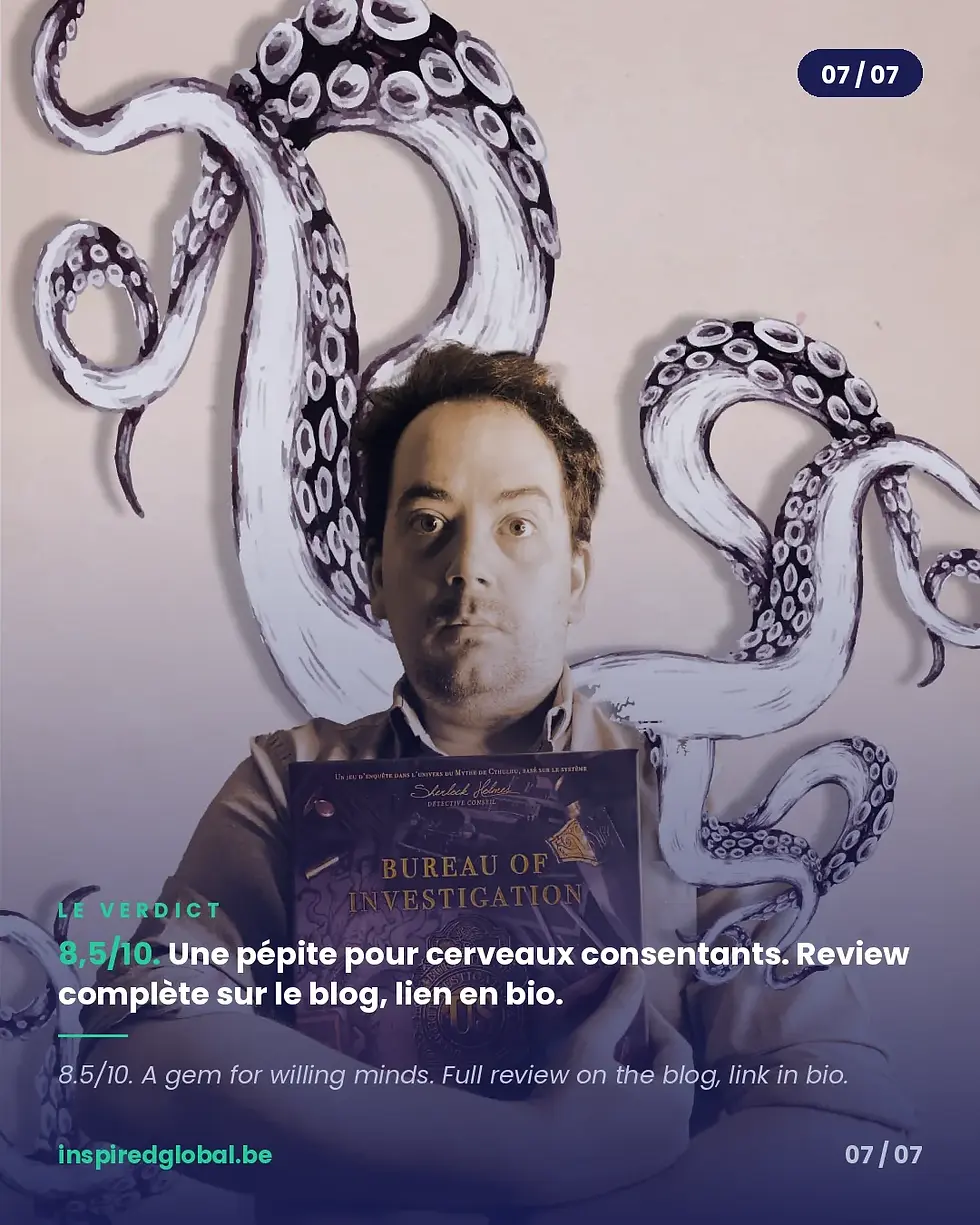
Verdict: 8.5/10, a must for consenting brains
Bureau of Investigation is high-end investigation gaming, not to be pulled out lightly on a tired Tuesday night. You have to prepare, concentrate, and above all surround yourself with people as motivated as you are. On that condition, it hands you a rare Lovecraftian immersion, real tension, and the delicious luxury of failing beautifully. It is not a flawless masterpiece, the uneven cases and the reliance on the theatre of the mind keep it from a perfect run, but for the lover of twisted mysteries and stories that scratch under the skin, it is a gem.
Dim the lights, cue an ambient soundtrack, and let the narrative dread consume you. We love it, and we want more.
Rating: 8.5/10. For those who love to think, accept losing, and sink into the Cthulhu Mythos together. Avoid if you are after visual action or a light evening.


Comments