
The Old King's Crown: a throne you don't grab, you earn

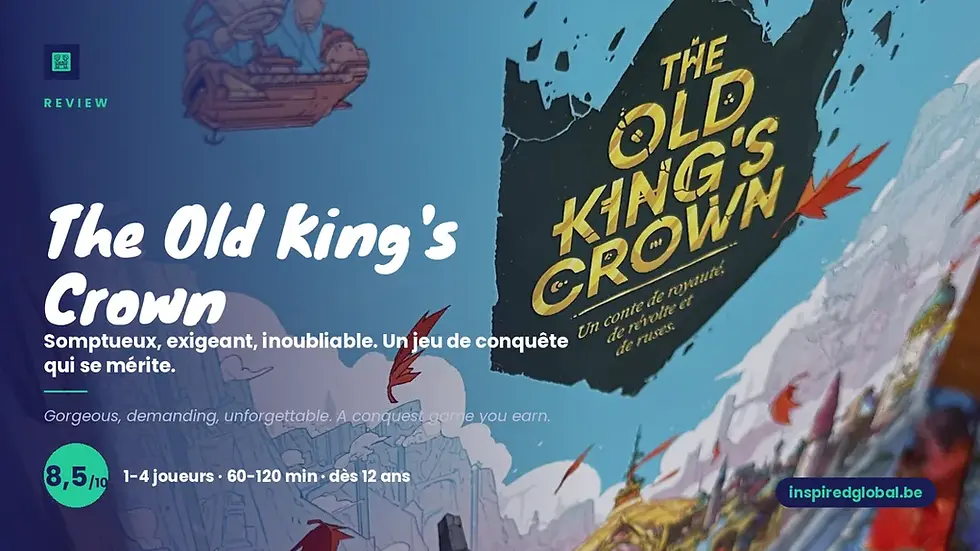
I sat down to start this game four or five times before I actually dared to play a full session. Every attempt, same story: I open the rulebook, I feel the sheer mass of it, and I close the box telling myself I'll get to it later. I even thought I'd found a back door through the solo mode, except the solo booklet is just as thick, so that escape route shut as fast as it had opened. It took me a while to digest everything and come back for real. And once the machine finally clicked into place, one thing was obvious: you can feel the school of Root hanging over every single turn. This is not a game you pick up after one round. This one, you have to work at. It will put plenty of people off, and yet it is absolutely worth it.
That Root instinct, by the way, is not just a hunch. In the acknowledgments, Pablo Clark thanks Cole Wehrle and Leder Games, the studio behind Root and Arcs, by name, for their help and direction during development. It's worth keeping in mind, because it explains a lot of what the game gets right and a lot of what pushes people away.
Playing time: 60-120 min · Age: 12+ · Players: 1-4 · Publisher: Eerie Idol Games, a small Scottish studio (2025) · Designer, illustrator & developer: Pablo Clark · Mechanics: card-driven conquest, asymmetric factions, hand management, betting and bluffing, deck construction, seasonal structure · Complexity: expert (3.65 on BGG) · My rating: 8.5/10.
A gorgeous kingdom falling to ruin
The old king is dead with no clear heir, and his realm, slowly reclaimed by the wilderness, is waiting for someone to take it. You play one of four factions fighting for the crown: the decadent Nobility that leans on defense, the Clans that trust in sheer numbers, the Uprising with its spies and dirty tricks, and the Gathering, a moon cult steeped in mystic philosophy. You need to reach a set number of Influence points to win, fifteen in most games, twenty at two players.
The first shock is visual. The Old King's Crown is the work of one man, Pablo Clark, a former video game artist who spent roughly twelve years designing, developing and illustrating the whole thing himself. The result is staggering for a single person: a watercolor art direction somewhere between Ghibli, Zelda and a darker Darkest Dungeon streak, where every card is a little window onto a dreamlike world. This isn't decoration slapped on top of the rules. Each faction has its own motifs, its tarot-like symbology, and that coherence eventually seeps into the whole session. The components match: dual-layer player boards, faction-specific sculpted and screen-printed meeples, wooden dials and tokens, high-quality cards. It is jaw-dropping stuff, the kind that alone justifies pulling the box off the shelf. Open it up and you understand at once that this is no casual filler, but an ambitious, dense designer game, and it owns that.
How it plays
The skeleton is surprisingly simple, which is probably why the game took off despite its reputation. Each round is a year split into four seasons. In Spring, you bid blind for Kingdom cards, place your Herald (a big meeple) on a Location as a statement of intent, then lay a face-down card next to each of the board's three Regions. In Summer, you resolve the battles Region by Region: reveal the cards, highest value wins, and the victor picks one of the two Locations in that Region to bank Influence and trigger its effect. Autumn is for journeying and governing, which is to say upgrading your deck and sending cards to the Council. Winter cleans up the board and advances the turn counter.
Under that skeleton, everything is tension. Your Herald only pays off if you win the battle where you placed it, and if a rival dropped theirs on the same spot, the winner steals a point from the loser. In a race to fifteen, a well-placed Herald can create a three-point swing in one blow, which fuels a constant mind game. Is that Herald there because your opponent holds unbeatable cards, or just to scare you into contesting somewhere else? Being last in turn order is no punishment either, since you get to choose the order in which Regions resolve, and that can change everything when some cards boost their neighbors.
The idea that holds it all together is attrition. Your deck doesn't just grow, it wears down: the moment you have to reshuffle your discard to draw again, you permanently lose a card from your hand size, tracked on a little dial. So you play as much to preserve your hand as to win battles, and every card becomes precious. Do you burn your big card to grab a coveted Kingdom card, to win a Region, or do you hold it for the Council? The game throws that kind of dilemma at you nonstop, and the slightest misstep costs you dearly.
Cards carry keywords that make the fights sing. Deadly kills the opposing cards regardless of value, unless they're protected. Ambush lets you add a card after your opponent has revealed theirs. Retreat pulls back a card you've already lost so you can reuse it later. And because battles resolve in Day and Night sub-phases, an effect played at the right moment can defuse a threat before it ever lands. If you've played the combat phase of Magic, you'll feel a little at home here, with the whole board layer stacked on top.
The asymmetry you have to earn
This is where the game sets itself apart. Unlike Root, where every faction runs on its own rules, the four factions in The Old King's Crown start with a mechanically identical deck of fourteen cards. The asymmetry doesn't hit you upfront, it reveals itself over the course of the game. Each one has its own powers, single-use Tactics tiles, a Kingdom's Favor dial that unlocks an ability, and above all exclusive upgrade cards you buy by spending Lore earned on journeys. The Uprising, for instance, can swap two of an opponent's cards before they're revealed, or force a rival to discard, while the Nobility plays conservation and defense.
That slow reveal is deeply satisfying, because the payoff matches the wait. On top of that sit fifty-one Kingdom cards, and you'll never see even half of them in a single game: they create a pool of possibilities that makes you want to come back and test other paths. That's the real replayability engine, and one thing you simply can't hold against the game.
A word on the solo mode, because it surprises everyone, myself included. On paper, a game whose whole flavor lives in the dirty tricks you pull on other players seems ill-suited to playing alone. Yet the Simulacrum, the automated opponent developed with a solo specialist, runs remarkably well: little management overhead, a real sense of personality, adjustable difficulty. I won't make it my main way to play, since the soul of this game is bluffing against real people, but it's one of the best automa systems I've handled.
What grates, and who it's for
Let me be blunt: you will not enjoy your first game, and probably not your second either. The barrier to entry is steep, the booklet is intimidating, and even the solo mode gives you no shortcut. The complexity comes less from the rules, which you pick up fairly quickly, than from the sheer mass of keywords, faction powers and unique cards you have to keep in your head, for yourself and for everyone else. Add that there's a lot of text to read, and that you'll need a big table to spread it all out.
The most divisive point is the player count, and here every review lands in the same place. At two, the game is more readable but merciless: one strategic mistake can be beyond recovery and the match slips away from you. At three, most reviewers, myself included, find the sweet spot, with constant swings and a game state you can still read. At four, it tips into chaos: every battle drags in everyone, powers fire off in all directions, and it becomes almost impossible to plan anything. Some love that dramatic circus, others see it as a loss of control and overly long games. This is a game that chases drama over balance, in the spirit of an Innovation, and you have to be into that.
As a result, The Old King's Crown splits people into two clear camps: those who swear by it, and those who bounce right off. I've read more than one reviewer acknowledge all its quality while admitting the magic never took for them, exactly like some people stay cold in front of Root where a Dune Imperium gives them instant gratification. That's not a flaw in the game, it's its nature: it demands investment and it makes no secret of it.
Verdict
The Old King's Crown isn't a game for everyone, and it doesn't pretend to be. For me it's an 8.5/10: a very good game, but not very accessible, so clearly a niche pick, saved and elevated by artwork and components that are jaw-droppingly good. Save it for players who love to dig into a system, come back to it, and watch a mechanism open up game after game. Bring it out with a motivated table, ideally at three, ready to weather a learning round without grumbling, not with newcomers on a weeknight. If you loved the depth and tension of Root or Arcs, this one deserves a real spot on your shelf, if only for an art direction among the most beautiful ever put in a board game. It doesn't give itself away, it makes you earn it, and that's exactly what makes it unforgettable for anyone willing to put in the hours.


Comments