
The Dark Quarter: the game I don't love and can't stop bringing back to the table


It's nearly midnight, the box is closed, and Ariane asks me the only question that matters after a game night: "Did you like it?" And for the first time in years of playing, I had no answer. "I don't know." We'd just wrapped the first act of The Dark Quarter, spread over several sessions, we'd had a good time, and we were completely unable to say whether we liked this game. Session after session, that uncertainty never went away, and I think that's exactly what we need to talk about.
A word of transparency first: I received this game from Lucky Duck Games. Which means I was sold in advance. I love what this publisher does with its hybrids, the Chronicles of Crime investigation line and above all Destinies, whose framework The Dark Quarter borrows. So I opened the box more excited than usual. Which makes my current confusion all the stranger to put into words.
Publishers: Van Ryder Games and Lucky Duck Games · Designer: Evan Derrick (Detective: City of Angels) · Illustrators: Jarek Nocoń and Mateusz Komada · Players: 1 to 4 · Playtime: 120 min and up per scenario · Age: 18+ · Mechanics: co-operative, narrative, app-driven investigation
What you do, without always knowing why
You play a detective from the Beaumont Agency, in a grimy, occult New Orleans of 1981, the one that handles the cases the police would rather ignore. The app runs the show: it narrates, handles the dialogue, the music, the consequences of your choices. You move freely from place to place, you search, you question, and when an action calls for tempting fate, you roll dice tied to your skills, with effort dice that run out fast. Every object card carries a QR code you scan to see what it reveals, a direct legacy of Chronicles of Crime. And this time, unlike Destinies where you switch avatar with every story, you keep the same investigator for the whole campaign: they earn experience between scenarios and grow case after case.
On paper, it's the perfect cocktail. In the first session, though, we mostly felt thrown into the middle of something we didn't control, with no idea what we were doing or why. You feel your way, you push forward, and little by little the story takes hold. If that sense of disorientation is a deliberate choice by the designers, then it works, you really are dropped into a case that's bigger than you. We just wish we'd had a little more guidance at the start, or a short introductory scenario to find our feet before being tossed into the deep end. That's the whole ambiguity of the game.
What pulls you in
During play, it works. The atmosphere is superb, the writing polished, New Orleans becomes tangible, humid and unsettling. You get caught up in the story, you debate every lead with Ariane, you want to know what comes next. The components are gorgeous and the app does its job as a storyteller well. In the moment, I'm all in. The problem is what happens once you close the box.
The flip side: an object that doesn't know what it is
My real issue is the format. There's a board, but it barely serves any purpose. To zoom in on a location you have to pull out cards and lay them off to the side, whereas Destinies brought its points of interest to life directly on a board that expanded before your eyes. The result is that the board becomes decorative. And if you remove that board and keep only the app and its locations, you're no longer playing a board game, you're playing a video game.
That's the crux of my confusion. What hooks us is the story. So then, why make it a board game? A good novel might do the job better, and a choose-your-own-adventure book would deliver without commandeering your dining table. Because commandeer it you must, and for a long time: you never know when a chapter ends, which makes an evening impossible to plan. We ended up setting everything aside mid-momentum because it was dinner time, and of course we were playing on the dinner table.
Then there's the app, where I have to flag two things. First, we'd have appreciated a voiced version of some of the text, because the passages are sometimes long and reading aloud eventually wears you out. But the real big, big problem is elsewhere: the app feels designed for smartphones. On a tablet the text shows up tiny, which kills the comfort and the fun mid-game, and nothing in the settings lets you enlarge the font. We're closing in on forty at home, so honestly, a little something for the old folks wouldn't hurt.
The last thing that bothered us is the language. The game is rated 18+ and owns it, but the crudeness of some passages felt gratuitous to us, put there more to tick the "mature" box than to genuinely serve the story. Others will read it as noir authenticity, we saw it as filler.
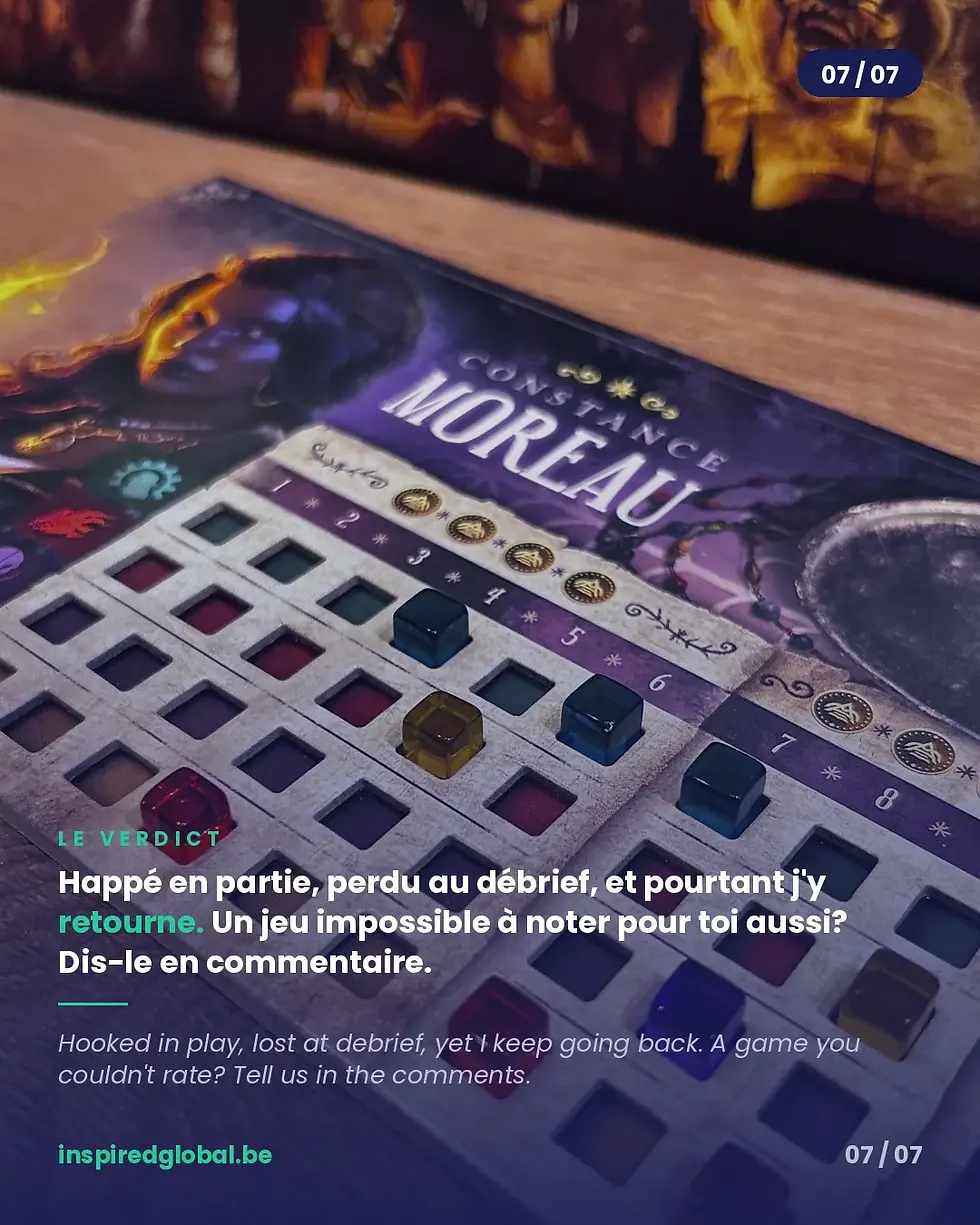
Verdict: baffled, and yet I keep coming back
Here's where I stand. Every session, I'm hooked. Every debrief, I wonder why I'm playing it, because it isn't quite a board game, not really a video game, and not a simple single-track story either. An object caught between two stools, one I can't decide is brilliant or misconceived. And yet I bring the box back out, because I want to know what happens next. Maybe that's the real achievement of The Dark Quarter: making me unable to say whether I love it, while making me want to return to it.
So who is it for? For you if you're after an immersive story above all and the medium doesn't matter to you, if you have whole evenings to spare and a reliable partner ready to finish the campaign. Give it a miss if you want a real board game in the tactile sense, if a screen at the table puts you off, or if you need to know, at the end of a night, whether you had fun.


Comments