
Minikin City: The Trick-Taking Game That Won Over an Allergic Player

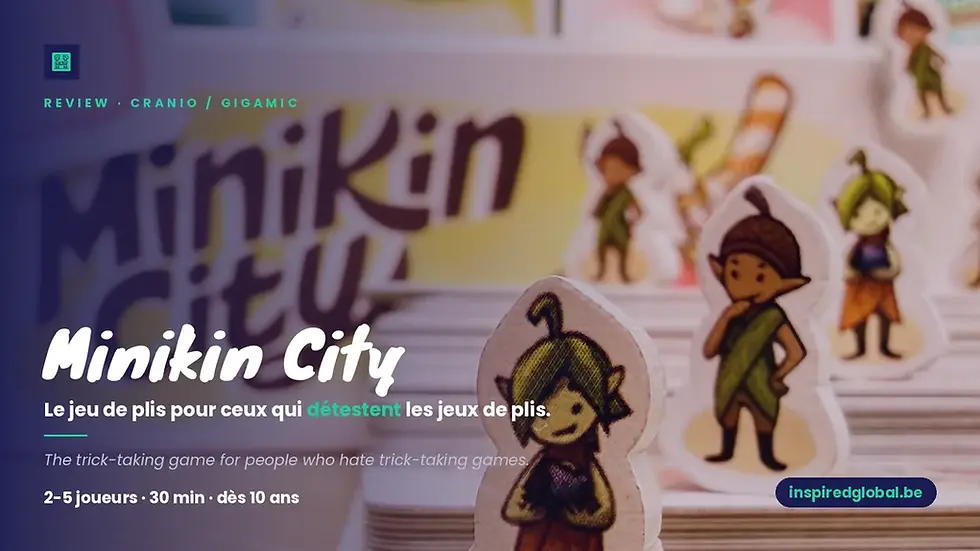
Let me start with a confession: I don't like trick-taking games. The Crew, praised just about everywhere, always leaves me with the same feeling, that of being locked inside my hand of cards, forced to follow the suit led, counting what has fallen and putting up with what's left. So when Minikin City arrived at home with the "trick-taking" label stuck on the box, I opened it warily. Several games later, at two, three and then four players, the verdict still surprises me: the trick-taking never felt oppressive. Every turn, I had the feeling I knew what to do. For an allergic player like me, that is close to a conversion, and the nicest card-game surprise since Take Time. (I haven't become a fan of The Crew, mind you. Let's not get carried away.)
Duration: 30 min · Age: 10+ · Players: 2-5 · Publisher: Cranio Creations · Distributor (France): Gigamic · Designers: Simone Luciani and Matthieu Verdier · Art: Kerri Aitken · Mechanics: trick-taking without following suit, tableau building, drafting · Release: September 2026
A Pocket-Sized City by Luciani
The setting is tiny, as the title promises. You build a city for the minikins, little creatures who ask for only one thing: a roof over their heads. The cards show houses, shops and neighbourhood corners, and each one offers one or more spots to house your residents. Kerri Aitken's artwork does the rest: round, colourful, full of details, the kind of place you want to stroll through. The box is small, but there is plenty inside: 61 City cards, 18 Reward cards and 75 minikins to place.
Behind this cute front stands Simone Luciani, one of the most respected names in Euro games (Grand Austria Hotel, Lorenzo il Magnifico, Tzolk'in), teamed up here with Matthieu Verdier. Luciani was also one of the common threads of my Essen 2026 selection, with Shugendo in a far meatier register. Minikin City is pocket Luciani: thirty minutes, rules you can explain quickly, and yet a real density of choices.
How It Plays
The game lasts eight rounds. In each one, a Reward card shows which colour matters and what is up for grabs. City cards come in three colours, numbered 1 to 20, plus a single card worth 21.
On your turn, you play a card from your hand. And here is the first piece of good news for allergic players like me: you never have to follow suit. You play whichever card you want. Once everyone has played, the cards are ranked: the round's colour comes first, then value breaks ties. The best-placed players collect the rewards: minikins, bonus tokens, points, or ribbons that will weigh in at final scoring.
This is where everything tips over. Whatever its rank, your card doesn't go to the discard pile: it joins your city. Its symbols add to your town, its effects trigger, and its spots wait for residents. End-game effects only pay off if you have filled the spots with minikins. An empty house is worth nothing.
Then you refill your hand. Everyone takes a card from the market, and the player who ranked last picks first. Whoever grabbed the reward makes do with the leftovers. After the eighth round, a final ranking is played with the cards still in hand, and the winner adds a ninth card to their city before scoring. Several reviewers compare the game to Faraway, and the kinship is clear: you line up cards that only make sense together.
Why the Tricks Didn't Smother Me
In a classic trick-taking game, your hand is a prison. You have to follow, and the question is not "what do I want to do?" but "what am I allowed to do?". In The Crew, add limited communication on top: you spend the game guessing what the others are hiding. That is exactly what wears me out.
Minikin City removes the bars. With no obligation to follow suit, every card in your hand stays playable, and the decision becomes readable. It boils down to one question: do I want this round's reward, or do I want this card in my city? Sometimes the two line up, and it's a joy. Often they don't, and you have to choose. But you always know what you are weighing up. The trick is no longer an end in itself, it is half of the decision.
Losing a round is no failure, by the way. Your card still builds your city, and you pick first at the market. I have deliberately played a weak card to get my hands on the card I wanted from the market. The game rewards that kind of calculated sacrifice, and that is what makes it so pleasant: you never feel like you are at the mercy of your hand.
What Works
The double reading of every card creates constant tension without ever turning into a brain-burner. The eight rounds fly by, and each one counts. The small pleasure of placing the last minikin that completes a house and triggers its effect is real, almost physical. Finally, the reverse draft acts as a natural catch-up mechanism: whoever runs ahead pays for it at the market, and nobody falls behind.
The format is just right. Thirty minutes, quick setup, a box that fits in a bag: it is the game you bring out at the start of the evening and immediately set up again, because on the last turn you finally understood what you should have done on the first.
The Flip Side
Interaction stays indirect. Everyone tends their own city, and you only look at the others' play to anticipate the ranking and the market. Players who love to throw a spanner in the works will be left wanting.
The first game is a little disorienting. You realise late how valuable minikins are and how important it is to leave spots to fill, and the first score tastes of "I'd do it all differently". Players who want to calculate everything can also slow the table down, since each card asks you to weigh two uses.

Player count matters too. At two, the game is clearly less tense, and the race for rewards loses much of its bite. At three and four, every reward becomes contested, and the choice between winning the round and picking first at the market comes into its own.
And one paradox: if you love trick-taking games, you may be disappointed. The tension of the trick, card counting, reading opponents' hands closely, all of that takes a back seat here. Minikin City uses the trick as an engine, not as the heart of the game.
Verdict
A favourite. Minikin City is a clever little game that proves you can borrow the trick-taking mechanism without keeping its constraints. It is made for players who usually run away from trick-taking games, for fans of Faraway and quick tableau builders, and for families with children aged ten and up, especially those who have already adopted Spooky Towerand are looking for the next step. I clearly recommend it from three players, which is where it shows its full potential. Bring it out to open an evening or to wrap up a session, when you want to think without wearing yourself out. And if, like me, you have a troubled history with The Crew, give it a chance. It might reconcile you with trick-taking, or at least with this one.



Comments