
Ministry of Lost Things, Finders Keypers: when the investigation is about your lost keys

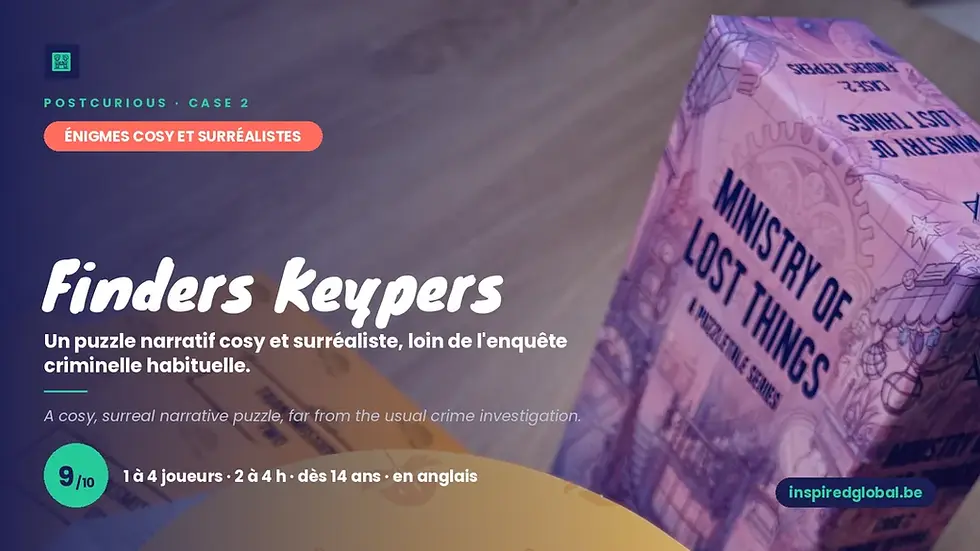
Where do vanished socks go, and the keys you could swear you hung on the wall? To a parallel world, and that is where the investigation begins.
One evening, at the dining-room table, I opened the box of Finders Keypers and very nearly closed it again. I was alone, too tired, and unable to get properly into it. I tried again another evening with a fresher mind, and this time it clicked. This second case of the Ministry of Lost Things series, published by PostCurious, demands real thought, and it has no mercy for sleepy brains.
Publisher: PostCurious
Distribution: PostCurious, also available from Allplay
Designers: Rita Orlov, Mark Larson, Chelsea Stark
Illustrator: Nicole Gustafsson
Players: 1 to 4
Duration: 2 to 4 hours advertised, over 4 hours for me, spread over several sittings
Age: 14+
Language: English, with a pencil and a connected device
A cosy universe, far from crime
You become a scout at the Department of Returns, the branch of the Ministry of Lost Things in charge of bringing misplaced objects back to their owners. They end up in the Elusiverse, a parallel world made of forgotten objects and memories, and this time you are helping Jenna reunite her keys and keychains with her carabiner, Cari. Keys are the running thread, right down to the puns. Each envelope holds documents to handle: journal pages, stickers, postcards, all illustrated with great warmth. You do not need to have played the first case, because Case 2 stands on its own.
For me, this is where the game stands out. We are a long way from Unlock and the usual crime investigations. Nobody is dead here, nobody is a suspect, and it is frankly refreshing.
What I enjoy as well is the universe: fully fantastical, but not in the vampires-and-werewolves vein. This is surrealism, with a parallel world that collects our lost belongings. It can only appeal to a Belgian, from the country of surrealism.
How you play
The game moves forward envelope by envelope. You open one, read, handle the material, search, then log into the Department of Records web portal to answer that envelope's questions. If everything is right, you are invited to open the next one. The portal stays discreet: you are not tied to your screen, you log in with a link sent by email, and your progress is saved. A tiered hint system is there if you get stuck.
The puzzles mix ciphers, logic, wordplay and pattern spotting. I will not spoil anything, but I will single out the card decoding in puzzle 2, which was really fun. And the difficulty climbs: the further you go through the envelopes, the harder it gets. It is a proper crescendo.
What hits home
On opening the box, I was first struck by how small it is. Then I lifted the lid and saw how well filled it is: everything needed for five envelopes of puzzles fits in there, without a scrap of empty space. The material is of fine quality, and you can feel real editorial work: paper, illustrations, document layout, everything is carefully done. For what you hold in your hands, the price seems very affordable to me.
As for the content, there is first the narration: a real story, carried by documents that make you feel as if you are rummaging through someone's file. Then the wordplay, which amused me overall and is everywhere. Finally, the puzzles are varied, and the whole thing holds up from start to finish.
What grates
There is the language. As a French speaker, I found the barrier moderate: you get by, but the puns call for real comfort in English, and they are at the heart of the game. There is also trial and error: the bikers puzzle is nice, but it frustrated me, and I groped around a lot before getting through it. Finally, the game demands thought, so avoid pulling it out on an evening when you have no brainpower left, like me the first time.

One piece of advice: since there is a real narrative, I recommend playing it in two sittings at most. Each envelope has its own questions, so picking it back up is no problem, but the more you break it up, the more you dilute the story. As for the single use, when you start this kind of game you know it is a one-shot, so it did not bother me. And the box contains what you need to reset the game: you can reinitialise it to replay, lend it or give it away.
Verdict
A firm yes for fans of narrative puzzles who want to step off the beaten path of Unlock and crime investigation, and who like a puzzle that tells a story. A firm no for anyone who does not read English at all. Good news for French speakers: Open Sésame Games is considering a French edition of some titles, though which ones is not yet known, and that could open the door to a much wider audience.
My score: 9 out of 10. Refreshing, high quality, affordable: I already want to play the other cases.
Comments