
Himizu: When Every Power Is a Gift to Your Opponent

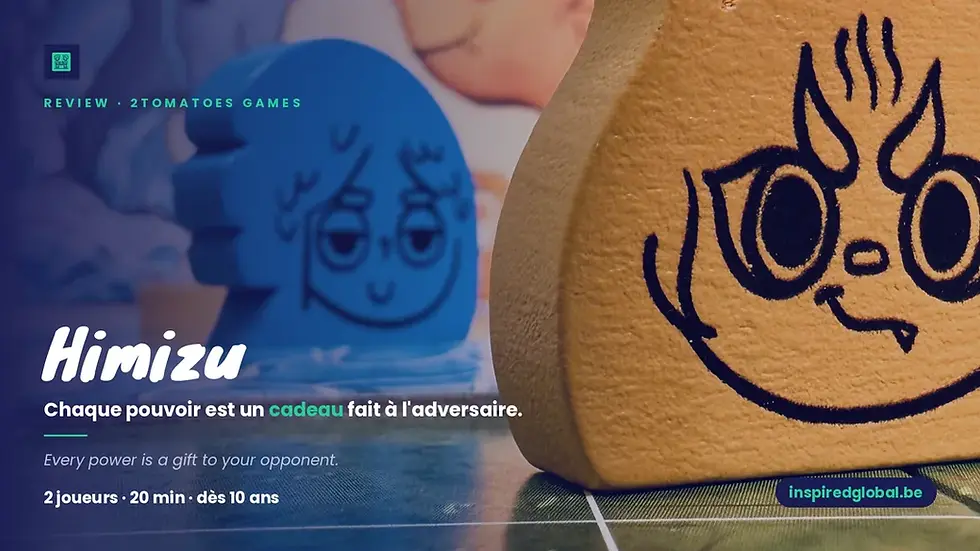
This Sunday morning, I read the rules of Himizu, then did what I often do with a duel before bringing it out for real: I sat on both sides of the table. One hand for fire, one hand for water, and a simulated game to see how the mechanics breathe. A few turns in, one thing struck me. Playing fire, I hesitated to use a power. Not because it was a bad move, but because I knew exactly who I would be paying for it: water, in other words me, three seconds later. All of Himizu lies in that hesitation. (Playing against yourself has at least one advantage: you can be sure your opponent didn't cheat.)
Duration: 20 min · Age: 10+ · Players: 2 (strictly) · Publisher: 2Tomatoes Games · Designer: Litus Carreras · Art: Ariadna Altimira and Litus Carreras · Mechanics: abstract, asymmetric, action points, area control · Languages: multilingual edition, English, French, German and Spanish · Availability: shown at Essen 2026, then in shops
A Duel Between Two Spirits
The name sets the tone, or rather both of them: in Japanese, "hi" means fire and "mizu" means water. Two elemental spirits fight over a clearing in a sacred forest. One wants to set it ablaze, the other wants to protect it. It is a small game from Spanish publisher 2Tomatoes, in a small box, with a sixteen-space board, illustrated wooden pieces and a handful of tiles and tokens.
Let's not kid ourselves: Himizu is an abstract game. The theme dresses up a mechanism, it doesn't carry it. But it was chosen with care, and you can feel it from the first read of the rules. Fire spreads, turning the land into burning tiles, then charred ones. Water douses, covers, slows down. Every power matches what you would expect from the element, so the rules stick without effort. One English-language reviewer joked that the water spirit's artwork has the face of someone who already knows they will spend the afternoon cleaning up somebody else's mess. That is exactly its job.
How It Plays
Fire opens the game with two flames on the board, water with a single wave. On your turn, you have three movement points to share between your pieces, and you can activate your side's own powers. Fire, for instance, can spread without moving, gaining ground where it hasn't set foot. Water moves its wave and lays puddles to lock down spaces.
The two sides are not chasing the same goal. Fire wins if all sixteen spaces hold a terrain tile at the same time, burning or charred. Water wins if it removes every flame from the board, or if it holds out until the end of the tenth round. That "at the same time" changes everything. Fire cannot advance space by space and bank its gains, since every flame put out opens a new hole. For fire, the game is a puzzle to finish before time runs out. For water, it is sabotage, and keeping a single space free at the right moment is often enough. If you know Hnefatafl, the old Viking game where attackers try to capture the king while defenders try to help him escape, you get the idea: two players on the same board, looking at two different problems.
Two Sides, Two Learning Curves
This asymmetry goes beyond different powers. The number of tokens, the starting pieces and the victory conditions differ too, and as a result, you don't learn the two sides the same way.
As water, you first feel like you are chasing fire. It places a flame, you put it out, and you react more than you play. The click comes when you realise you have to play ahead: spot the spaces fire will need later and make them hard to reach before they catch. Fire is the opposite. It looks simple, since all you have to do is spread. Until you notice that by covering the board, you are cutting down your own movement options. Each side has its beginner's trap, and the best advice I can give you is to swap roles from one game to the next.
Space is tight, after all. Sixteen spaces is very few, and none of them is safe. With three moves per turn, distance becomes a resource: a space four moves away is out of reach this turn, at three it is yours. A single extra move can turn a game around. And that extra move, precisely, comes at a price.
What Works: Powers on Credit
This is Himizu's big idea, and the one that won me over. To activate a power, you spend tokens. But those tokens don't go back to the supply: they go to your opponent, who can use them on their turn to trigger their own abilities. Every flashy move is paid for twice, once from your hand and once into theirs.
Using a power is like taking out a loan your opponent collects the interest on next turn. As a result, you sometimes give up a move you wanted to make, just to avoid handing them ammunition. You have to measure, weigh, pick the moment when the edge you gain is worth the one you give away. The whole game is about finding that balance, and it shifts every turn. It is a simple idea that fits in one sentence of the rulebook, and it is enough to give weight to every decision on a tiny board.
The Flip Side
The first weakness is the one almost every abstract game shares: the theme remains a wrapper. Neat, consistent, nicely illustrated, but a wrapper. If you are looking for a story or an atmosphere, you won't find it here. Himizu is played for the pleasure of calculation and reading your opponent.

The second follows from the first. With no luck and no hidden information, the game's lifespan depends entirely on how interesting the board situations remain. Between two players who enjoy digging into openings and timing, it can last a long time. Facing someone who likes a bit of the unexpected, it may run out of steam. One honest caveat, finally: my opinion rests on reading the rules and a simulated game. Real two-player games will tell whether the balance between fire and water holds over time.
Verdict
Himizu is a short, clever, nicely wrapped abstract duel, built around one strong idea: every power you use makes your opponent stronger. It is aimed at fans of two-player games who like to think without spending the whole evening on it, at gaming couples looking for a twenty-minute match after dinner, and at anyone who enjoys bold asymmetry. If you liked the head-to-head clash and multiple victory conditions of SAN, or if you are looking for a change after an adventure best savoured as a pair like Lost in Adventure, keep an eye on it. It will be shown at Essen, which I started previewing here. Stop by the 2Tomatoes booth, take fire, then ask for a rematch as water.
Comments